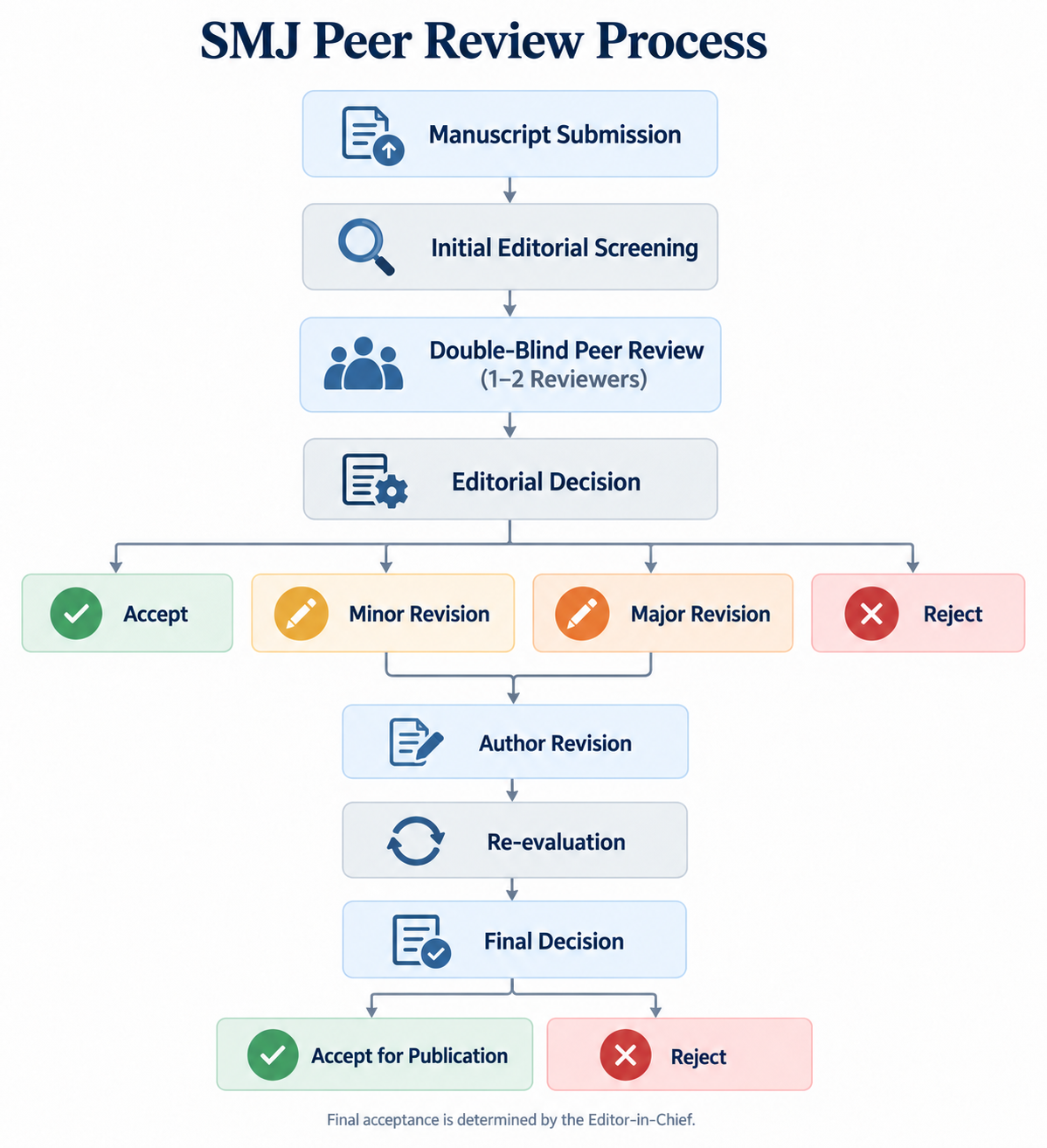
Peer Review Process
Sinnun Maxillofacial Journal (SMJ) is committed to maintaining scientific integrity, academic quality, and transparency throughout its editorial and publication processes. All submitted manuscripts undergo an editorial assessment followed by a double-blind peer review process to ensure that publication decisions are based on scientific merit, originality, methodological quality, and relevance to the journal's focus and scope.
The peer review process consists of the following stages:
1. Initial Editorial Screening
Upon submission, each manuscript undergoes an initial screening by the editorial team to assess its suitability for publication in SMJ. This preliminary evaluation includes:
-
Relevance to the journal's focus and scope.
-
Compliance with the journal's author guidelines and manuscript preparation requirements.
-
Originality and scientific contribution of the study.
-
Completeness of the manuscript, including ethical considerations and required supporting documents.
-
Clarity of presentation, academic writing quality, and adherence to scientific reporting standards.
Manuscripts that do not meet these requirements may be returned to the authors for technical corrections or declined without proceeding to external peer review.
2. Double-Blind Peer Review
Manuscripts that successfully pass the initial screening are assigned to one to two independent reviewers with relevant expertise in the subject area.
SMJ implements a double-blind peer review system, in which the identities of both authors and reviewers are concealed throughout the review process. To maintain anonymity, identifying information, including author names, institutional affiliations, acknowledgments, and other potentially identifiable details, must be removed from the manuscript provided for review.
Reviewers are expected to provide independent, objective, and constructive evaluations while maintaining the confidentiality of the manuscripts and declaring any potential conflicts of interest.
3. Scientific Evaluation Criteria
Reviewers are invited to evaluate manuscripts based on the following criteria:
-
Originality and significance: The novelty of the research, its contribution to existing scientific knowledge, and its relevance to dentistry and oral health sciences.
-
Scientific and methodological quality: The appropriateness of the research design, sampling methods, data collection procedures, statistical analyses, and ethical considerations.
-
Validity and reliability: The accuracy, consistency, and scientific credibility of the research findings.
-
Results and interpretation: The clarity of the results, appropriateness of the interpretation, and consistency of the conclusions with the available evidence.
-
Scientific presentation: The organization, coherence, academic language, quality of tables and figures, and accuracy and relevance of references.
-
Relevance and potential impact: The scientific, clinical, educational, or public health implications of the research.
Reviewers are also encouraged to identify methodological limitations, potential duplication of previously published work, and areas requiring clarification or improvement.
4. Editorial Decision
Following the completion of peer review, the handling editor evaluates the reviewers' reports and recommendations. When necessary, the editor may consult additional reviewers or members of the Editorial Board before reaching an editorial recommendation.
Based on the scientific evaluations, manuscripts may receive one of the following decisions:
-
Accept: The manuscript is accepted for publication, either without further modification or subject to minor editorial adjustments.
-
Minor Revision: The manuscript requires limited modifications or clarifications that do not substantially affect its scientific content or conclusions.
-
Major Revision: The manuscript requires substantial improvements related to its methodology, analysis, interpretation, or presentation before further consideration.
-
Reject: The manuscript is considered unsuitable for publication due to insufficient originality, significant methodological weaknesses, inadequate scientific contribution, major interpretative concerns, or failure to meet the journal's editorial standards.
An invitation to revise a manuscript does not guarantee its eventual acceptance for publication.
5. Manuscript Revision and Re-evaluation
Authors invited to revise their manuscripts are expected to address the reviewers' and editors' comments carefully and comprehensively.
The revised submission should include:
-
A revised manuscript incorporating the requested modifications.
-
A detailed point-by-point response to each reviewer and editorial comment.
-
Clear identification of revisions made to the manuscript, as instructed by the editorial team.
-
A scientific justification for any recommendations that have not been incorporated.
Authors are responsible for ensuring that the revised manuscript maintains consistency and accuracy in its scientific content, terminology, statistical reporting, references, tables, and figures.
Depending on the extent and nature of the revisions, the revised manuscript may be reassessed by the handling editor or returned to the original reviewers for further evaluation. Additional rounds of revision may be requested when necessary.
6. Final Editorial Decision
The Editor-in-Chief holds the final authority to accept or reject a manuscript for publication. Final decisions are based on the reviewers' recommendations, the authors' responses to requested revisions, the manuscript's scientific quality, and its compliance with the journal's editorial policies.
The Editorial Board reserves the right to recommend editorial modifications to improve clarity, consistency, language, formatting, and overall presentation without altering the scientific meaning of the manuscript.
Manuscripts containing substantial grammatical, spelling, formatting, or technical errors may be returned to the authors for further correction or rejected if they fail to meet the journal's publication standards.
7. Confidentiality and Ethical Standards
SMJ is committed to maintaining confidentiality, impartiality, and ethical responsibility throughout the peer review process. Editors and reviewers are expected to treat all submitted manuscripts as confidential scholarly documents and to avoid disclosing or using unpublished information for personal or professional advantage.
All participants in the editorial process are expected to disclose potential conflicts of interest and adhere to principles of fairness, objectivity, and research integrity.
Editorial decisions must be based on the scientific merit of the manuscript and must not be influenced by the authors' institutional affiliations, nationality, gender, or personal background.
Through this structured peer review process, Sinnun Maxillofacial Journal aims to ensure that published articles meet appropriate scientific and ethical standards while contributing meaningfully to the advancement of dental research, education, and clinical practice.